Active Directory and Group Policy changes along with a current user status list are provided through the EventSentry web reports, the recommended method for ADMonitor reporting.
The ADMonitor reporting application supports a number of scheduled and on-demand reports that may not be available through the EventSentry web reports. The ADMonitor Reporting application provides reports such as:
•A list of all computers, groups or organizational units
•A list of users that have never logged on
•A list of users that have logon or workstation hour restrictions
|
Active Directory and Group Policy changes along with a current user status list are provided through the EventSentry web reports, the recommended method for ADMonitor reporting. |

Reports are divided into either Object Status or Object Change reports and can be scheduled to run at a certain time of the day. Reports are always generated in HTML format.
Report Type |
Run On-Demand? |
Schedule? |
Create & Customize |
Object Change |
No |
Yes |
Yes |
Object Status |
Yes |
No |
No |
Reports - Object Changes
The reporting application includes a number of out of the box reports and additional reports can be created with the New button. Object Change reports cannot be run on-demand, they can only be scheduled with a Daily, Weekly or Monthly schedule.
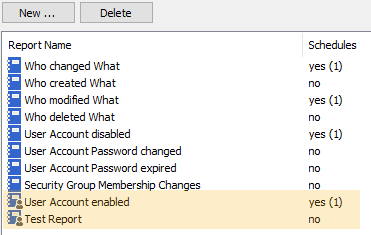
Built-In reports that ship with EventSentry, cannot be modified. To customize an existing report, create a new report - using a built-in report as a template - and then customize the new report instead. Reports created by users are easily distinguishable through a different report icon that includes a user symbol - see screenshot below.
Reports - Object Status
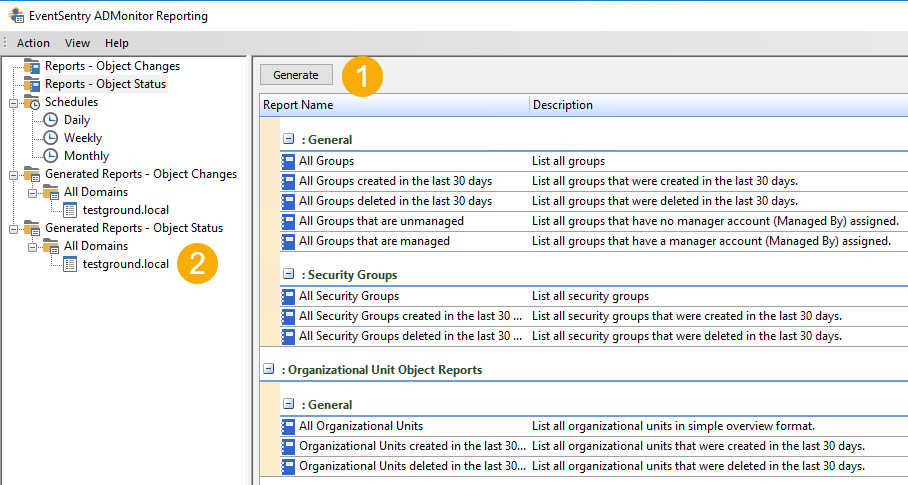
Object status reports only support pre-defined reports and can be run by selecting a report and clicking the Generate (1) button. Generated reports show up in the Generated Reports - Object Status (2) section.
Generating object status reports on demand
Schedules
Daily
Contain AD changes from the previous calendar day.
Weekly
Contain AD changes from the previous calendar week (Mon - Sun).
Monthly
Contain AD changes from the previous calendar month (1st - 28/29/30/31th).
It's important to note that the time range for Weekly & Monthly schedules always applies to a calendar day/week/month and not the previous 7 or 28/29/30/31 days. A monthly report that is triggered on April 18th will always include data from the month of March.